
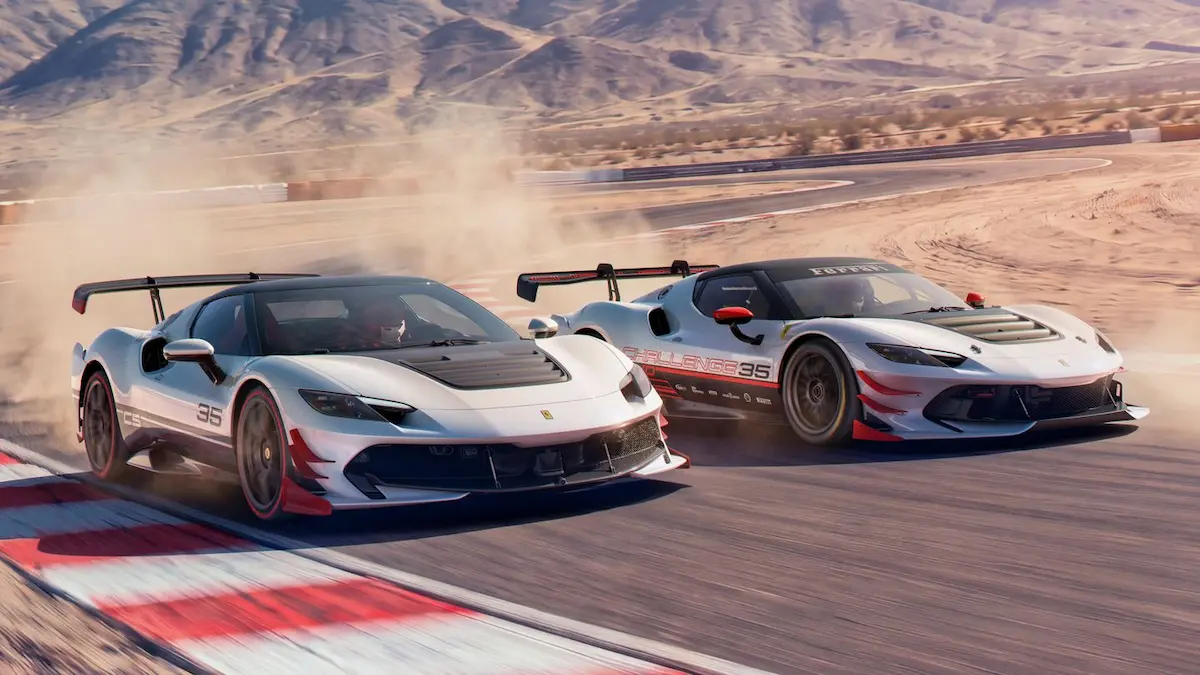
Ferrari reveals the 296 Challenge Stradale and 296 Challenge Evo, featuring non-hybrid twin-turbo V6 engines producing 670 PS and 700 PS.
Ferrari has unveiled two new V6-powered performance machines at Finali Mondiali 2026 in Barcelona. The 296 Challenge Stradale and 296 Challenge Evo take different approaches to performance, but share one significant characteristic: neither uses a hybrid powertrain.
While electrification has become an important part of Ferrari’s modern performance strategy, these two models focus on reduced weight, sharper responses and a more direct connection between driver and machine.
The 296 Challenge Stradale is designed for road use, while the 296 Challenge Evo has been developed specifically for the Ferrari Challenge racing series.
Ferrari 296 Challenge Stradale Delivers 670 PS
The road-legal 296 Challenge Stradale features a 2,992 cc twin-turbocharged V6 engine producing 670 PS and 740 Nm of torque.
Power is delivered to the rear wheels through an eight-speed dual-clutch transmission.
Without the additional weight of a hybrid system, Ferrari has reduced the car’s dry weight to just 1,330 kg, making it approximately 140 kg lighter than the 296 GTB.
Performance figures are equally impressive:
- 0–100 km/h: 2.8 seconds
- 0–200 km/h: 7.9 seconds
- Top speed: Over 300 km/h
- Fiorano lap time: 1 minute 18.5 seconds
Aerodynamics play a major role in the car’s development. A fixed rear wing, redesigned front splitter and revised underbody generate 617 kg of downforce at 250 km/h, representing a 72% increase compared with the standard 296 GTB.
Carbon-ceramic brakes, specially calibrated suspension and Pirelli P Zero R tyres further underline its track-focused character.
Ferrari 296 Challenge Evo Takes Performance to 700 PS
The 296 Challenge Evo takes the same philosophy further, with a specification developed exclusively for racing.
Its non-hybrid 3.0-litre twin-turbo V6 produces 700 PS and is paired with a seven-speed dual-clutch racing transmission.
Ferrari has also introduced a revised aerodynamic package offering two configurations: High Downforce for maximum cornering performance and Low Drag for improved straight-line efficiency.
According to Ferrari, the new package generates 12% more maximum downforce than the previous 296 Challenge.
During testing at Mugello, the Challenge Evo recorded a lap time 0.8 seconds quicker than its predecessor.
The new racing model is scheduled to compete in the Ferrari Challenge series from the 2027 season.
Why Ferrari Has Removed the Hybrid System
The introduction of these models does not signal Ferrari’s departure from hybrid technology.
Instead, the Italian manufacturer is demonstrating that reduced weight and carefully developed combustion engines remain valuable tools in the pursuit of performance.
For the 296 Challenge Stradale, removing the electric motor and battery reduces mass while providing a more direct relationship between throttle input and engine response.
The Challenge Evo applies the same principle to a dedicated racing environment, where consistency, aerodynamic efficiency and driver feedback are essential.