
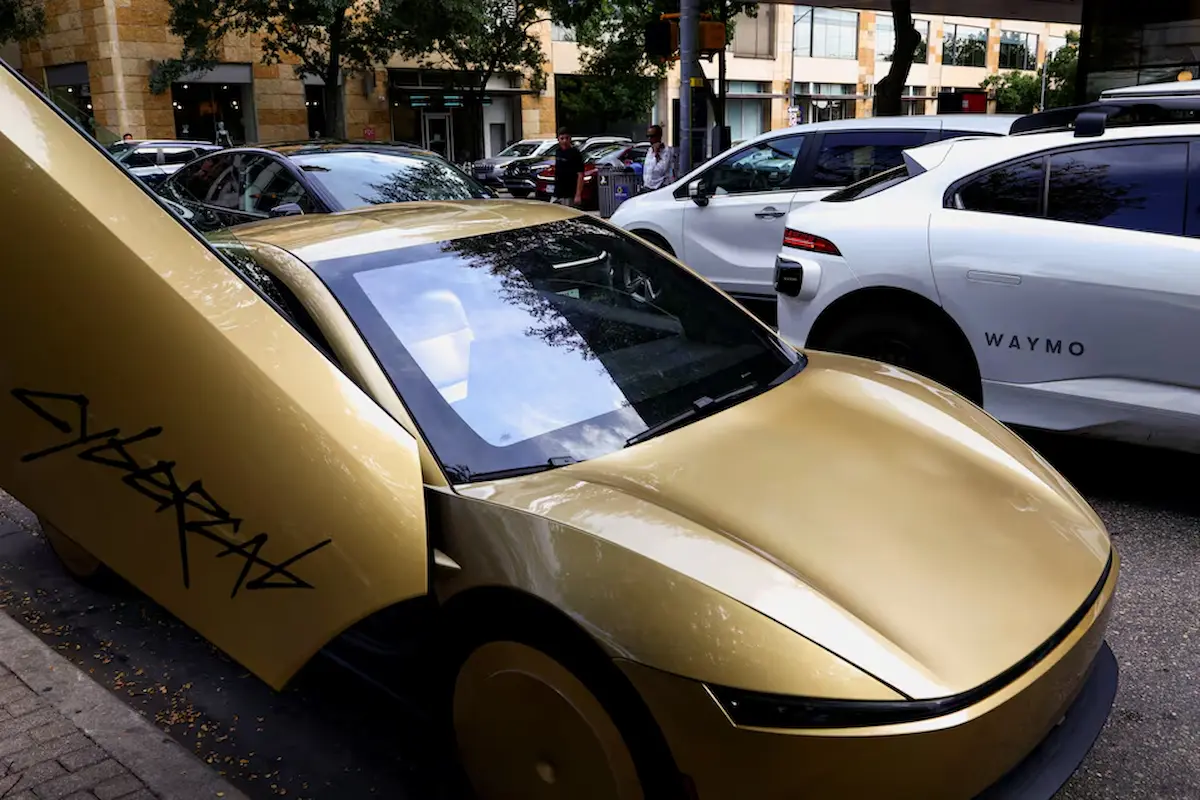
Tesla Cybercab is operating in Austin, but NHTSA is investigating whether the steering-wheel-free robotaxi complies with federal safety standards.
Tesla has begun deploying its purpose-built Cybercab for rides in Austin, Texas, but the steering-wheel-free robotaxi has immediately attracted regulatory attention. The U.S. National Highway Traffic Safety Administration (NHTSA) has opened an investigation into Tesla’s self-certification of the vehicle, raising a much bigger question: how should decades-old vehicle safety rules apply to a car designed to operate without a human driver?
Why Is NHTSA Investigating the Tesla Cybercab?
The Cybercab is fundamentally different from a conventional passenger car. The two-seat autonomous vehicle has no steering wheel, pedals or traditional mirrors, features normally associated with federal vehicle safety requirements.
In the United States, manufacturers can generally certify themselves that their vehicles comply with applicable Federal Motor Vehicle Safety Standards (FMVSS). NHTSA can then investigate whether that certification is valid.
Tesla has taken this self-certification route with the Cybercab.
Following its commercial deployment in Austin, NHTSA opened an Audit Query covering the basis on which Tesla certified up to 1,000 Cybercabs. The regulator will examine the technical data and processes Tesla used, including whether the company determined that some requirements written for human-driven vehicles simply do not apply to the Cybercab.
Why Didn’t Tesla Apply for an Exemption?
This is where the story becomes particularly important.
Manufacturers can apply for federal exemptions when vehicles do not comply with existing safety standards. However, Reuters reports that this route can limit commercial deployment to 2,500 vehicles per year.
That would be difficult to reconcile with Tesla’s ambitions.
Elon Musk has positioned Cybercab as a future high-volume vehicle and a central part of Tesla’s plan to build a large autonomous ride-hailing network. Tesla began Cybercab production in April 2026, although Musk said initial production would be slow.
By arguing that Cybercab already complies with applicable federal standards, Tesla could potentially avoid the 2,500-vehicle exemption limit — provided regulators accept the company’s interpretation.
Zoox Tried a Similar Approach
There is already an important precedent.
Amazon-owned Zoox previously attempted to self-certify its purpose-built autonomous vehicle, which also lacks conventional driving controls. NHTSA investigated, Zoox eventually withdrew that certification claim and later received an exemption for limited commercial deployment.
That history suggests Tesla could face a significant regulatory battle if NHTSA rejects its interpretation of existing rules.
Reuters also reports that a disagreement between Tesla and NHTSA over self-certification could ultimately end up in court.
Cybercab Is Already Operating in Austin
Tesla has not waited for the regulatory debate to be resolved.
Cybercabs have joined the company’s robotaxi operation in limited areas of Austin, Texas, alongside autonomous Model Y vehicles. Unlike the Cybercab, Model Y retains conventional controls such as a steering wheel and pedals.
This distinction matters because many existing federal standards were written around vehicles controlled by humans.
NHTSA itself acknowledges that those regulations need updating. The agency says it is working on multiple rulemakings involving areas including brake pedals, windshield wipers, lighting and rear-view mirrors to better accommodate automated vehicles. Until those changes are completed, however, the existing standards remain in force.
The Decision Could Go Beyond Tesla
The Cybercab investigation is therefore about much more than one Tesla model.
If Tesla successfully demonstrates that a purpose-built driverless vehicle without conventional controls can comply with today’s regulations without a special exemption, it could create an important path for large-scale autonomous vehicle deployment.
If NHTSA disagrees, Tesla’s plans to rapidly expand Cybercab could face a major regulatory obstacle.