

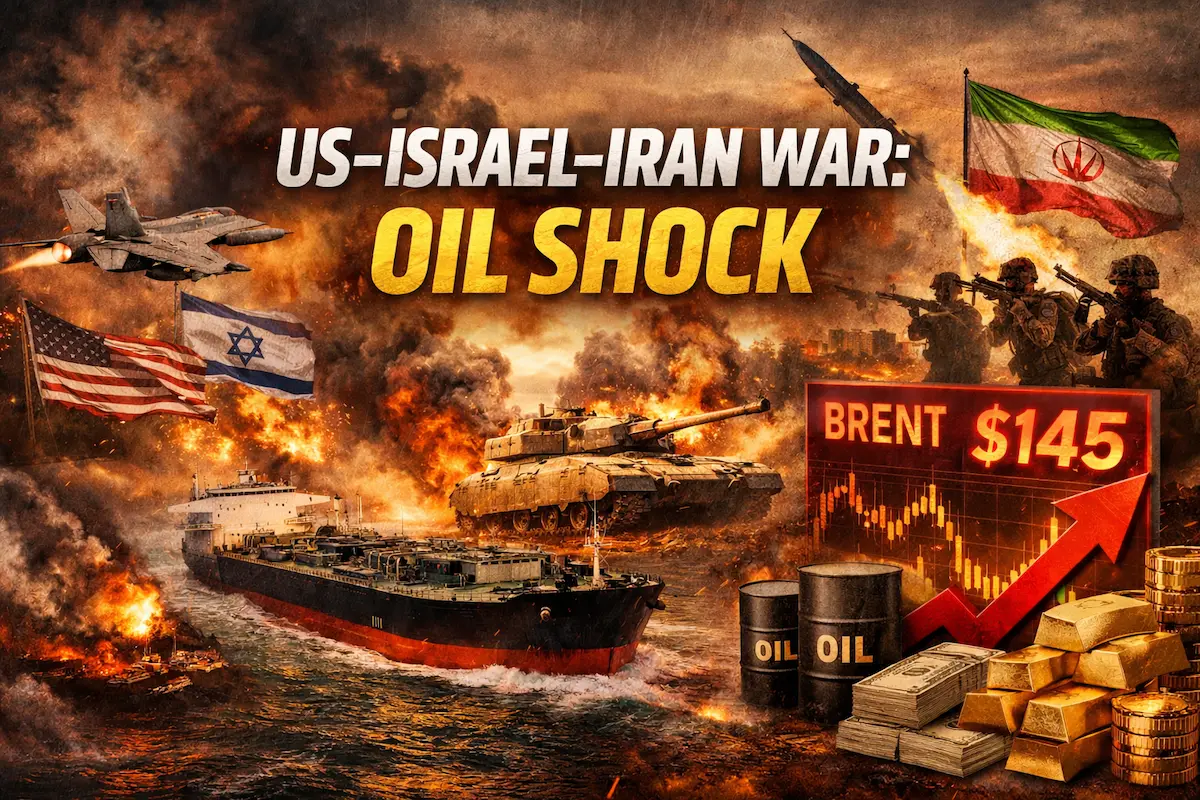
The US–Israel–Iran war escalates as Iran closes the Strait of Hormuz, sending oil, gold and global markets into turmoil. Full impact analysis.
US Israel Iran War Oil Shock Reshapes Global Markets
As of March 1, 2026, the US Israel Iran war oil narrative has shifted from regional tension to full-scale geopolitical shock. Following direct military escalation between the United States, Israel, and Iran, Tehran announced the closure of the Strait of Hormuz, triggering immediate turmoil across global energy markets.
This is no longer a “risk premium” story. This is a structural supply shock.
With nearly 20% of the world’s traded oil passing through Hormuz, the decision by Iran effectively weaponizes energy flows. Meanwhile, Israel and the United States have increased military deployments across the region, raising fears of a prolonged confrontation.
Why the Strait of Hormuz Matters
The Strait of Hormuz connects the Persian Gulf to global shipping lanes. On average:
- 17–20 million barrels of crude oil transit daily
- Key exporters include Saudi Arabia, UAE, Kuwait, Iraq
- LNG shipments to Asia heavily depend on this corridor
A sustained blockade would represent the most significant disruption to global oil flows since the 1970s energy crisis.
Initial market reaction has been aggressive. Brent crude surged sharply in early trading, with analysts warning that prolonged closure could push oil toward $140–$150 per barrel.
Oil, Gold and Commodities: What to Expect
The US Israel Iran war oil crisis is triggering classic safe-haven dynamics.
Oil
- Immediate supply premium
- Higher tanker insurance costs
- Strategic petroleum reserves may be released
- Risk of military escort operations
Gold
Gold traditionally rallies during geopolitical escalation. If conflict expands, new highs would not be surprising as investors hedge against systemic uncertainty.
Broader Commodities
- Industrial metals may fluctuate depending on recession fears
- Shipping rates likely to spike
- Energy equities may outperform short term
Markets are now pricing not only disruption — but duration.
Three Scenarios for Oil Prices
1. Short-Term Disruption (days):
Volatility spike followed by partial normalization.
2. Multi-Week Closure:
Oil above $150 becomes realistic.
3. Direct US Military Intervention in Hormuz:
Energy shock + global recession probability rises sharply.
Energy is embedded in every supply chain. Higher oil means higher transportation costs, higher production costs, and ultimately inflation.
Impact on Automotive and Industry
This is where the story becomes unique for an automotive-focused platform.
Higher oil prices affect:
- Plastics and petrochemical components
- Global shipping and logistics
- Manufacturing costs
- Consumer fuel expenses
If oil remains elevated:
- ICE vehicle operating costs rise
- EV demand may accelerate
- But electricity generation costs may also increase in fossil-dependent regions
Automotive margins could tighten. Vehicle prices may face renewed upward pressure, particularly in energy-importing economies.
The 2020 supply chain crisis showed how quickly production can stall when logistics tighten. A Hormuz disruption risks reopening that chapter.
Inflation and Central Banks
Energy-driven inflation complicates monetary policy.
- Central banks may delay rate cuts
- Emerging markets could face currency pressure
- Sovereign bond yields may rise
The US Israel Iran war oil shock is not only a Middle East story it is a global macroeconomic event.